
Doula vs. Midwife: Understanding the Difference, and Why Many Families Choose Both for Home Birth

When you begin exploring your birth options, two roles often come up: midwives and doulas.
They’re both deeply rooted in supporting physiologic birth.
They both believe in honoring your autonomy and your experience.
But they are not the same, and understanding the difference can completely shift how you build your birth team.
For many families planning a home birth, the question isn’t midwife or doula…
it’s whether having both creates a more supported, grounded, and empowered experience.
What Is a Midwife?
A midwife is your clinical care provider. Someone trained to care for you medically throughout pregnancy, birth, and the postpartum period.
Midwifery care is built on the understanding that birth is a normal physiologic process, while also holding the responsibility of recognizing when something moves outside of that normal.
Your midwife is trained to:
Provide comprehensive prenatal care (labs, assessments, monitoring growth and wellbeing)
Support labor and birth while monitoring maternal and fetal health
Recognize deviations from normal and respond appropriately
Manage normal birth and immediate newborn care
Provide postpartum and newborn follow-up care
In a home birth setting, your midwife brings both clinical skill and quiet attentiveness into your space.
She is always holding awareness of:
Your vital signs
Your baby’s well-being
The progression of labor
The safety of the environment
Even when she appears calm and hands-off, there is constant clinical assessment happening in the background.
What Is a Doula?
A doula is a non-clinical support person whose sole role is to support you emotionally, physically, and mentally through your experience.
Doulas are not responsible for medical care.
They are responsible for you.
A doula’s support often includes:
Continuous emotional reassurance and presence
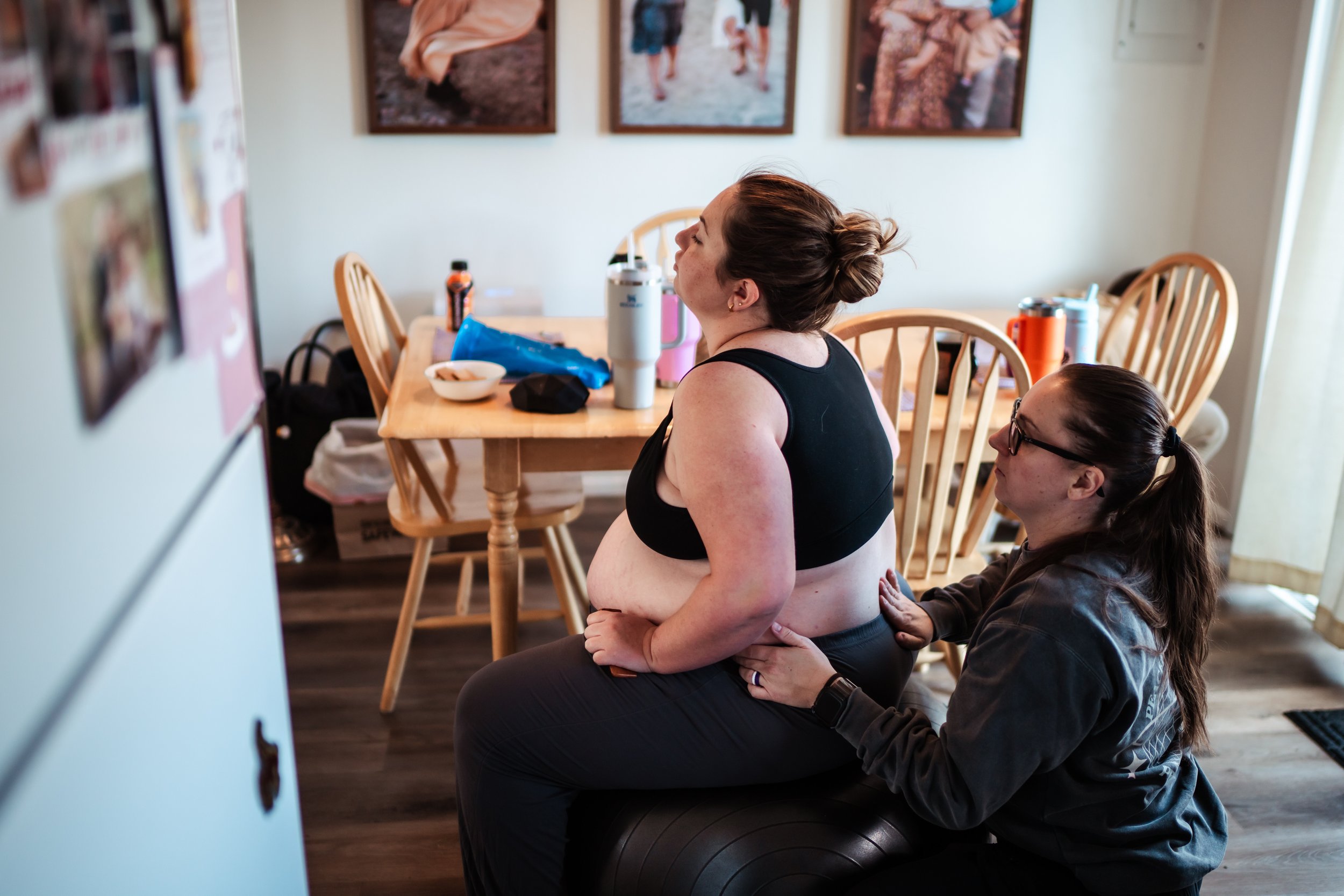
Physical comfort techniques (massage, counterpressure, positioning)
Helping you find rhythm and breath during labor
Holding space during intense or vulnerable moments
Supporting your partner so they feel confident and involved
Protecting the energy and environment of your birth space
Unlike any other role on your birth team, a doula is there without divided attention.
She is not charting.
She is not assessing vitals.
She is not preparing medications or newborn equipment.
She is simply with you.
The Core Difference
At its heart, the difference comes down to responsibility and focus.
A midwife is responsible for the clinical safety of you and your baby
A doula is devoted to your experience of the journey
One is watching for what’s happening medically.
The other is attuned to what’s happening emotionally, physically, and energetically.
Both matter.
Why This Difference Matters in Home Birth
Home birth is often chosen for its:
Intimacy
Autonomy
Unhurried pace
Respect for physiologic birth
But even in this setting, your midwife is still holding a clinical role.
She may step in and out of the room.
She may be quietly charting.
She may be preparing supplies behind the scenes.
This is part of safe, responsible care.
A doula fills in the space that remains, offering continuous, grounded presence.
The Benefits of Hiring a Doula for Home Birth
While a doula is never required, many families find that having one creates a noticeably different experience.
Here’s what that can look like in practice:
Continuous Presence From Early Labor Onward
Midwives are typically called once labor is well established.
A doula can support you much earlier, sometimes from the very beginning.
This means:
Guidance in early labor when you’re unsure what’s normal
Support staying home longer and more comfortably
Help conserving energy and avoiding early exhaustion
That early support can shape the entire flow of your labor.
Physical Support That Supports Physiology
Labor is deeply physical, and how you move through it matters.
Doulas are trained in techniques that can:
Encourage optimal fetal positioning
Reduce tension in the body
Support effective contractions
Ease discomfort without disrupting labor
Things like:
Counterpressure during back labor
Position changes to help baby rotate
Rebozo techniques
Water support and grounding touch
These are not “extras”, they often directly support how smoothly labor unfolds.

Emotional Safety and Nervous System Support
One of the most overlooked aspects of birth is how much the nervous system impacts labor.
When you feel:
Safe
Supported
Undisturbed
Your body is more able to:
Release oxytocin
Maintain effective contractions
Allow labor to progress naturally
A doula helps protect that space.
She notices when fear creeps in.
She helps you soften instead of resist.
She brings you back to your breath, your body, and your rhythm.
This isn’t just emotional, it’s physiological.
Support for Your Partner (Without Replacing Them)
Many partners want to be deeply involved, but don’t always know how.
A doula:
Guides them in real-time (where to apply pressure, how to support positions)
Offers reassurance during intense moments
Gives them space to rest without leaving you unsupported
Instead of feeling overwhelmed, partners often feel more confident and connected.
Holding the Energy of the Space
Home birth environments matter.
A doula helps:
Keep the space calm and intentional
Minimize unnecessary noise or disruption
Maintain a sense of grounding when things intensify
This is subtle, but powerful.
Birth often unfolds best when it feels protected and uninterrupted.
Evidence-Based Outcomes
Research has consistently shown that continuous labor support (like that provided by doulas) is associated with:
Lower rates of interventions
Shorter labors
Increased satisfaction with the birth experience
Even in home birth—where intervention rates are already low, these benefits often translate into a smoother, more supported experience.
Do You Need a Doula for a Home Birth?
No.
Many families have beautiful, supported home births with just their midwife.
But those who choose to include a doula often describe:
Feeling more held throughout the entire process
Having better tools to move through intensity
Experiencing less fear and more trust in their body
Looking back on their birth feeling deeply supported, not just medically, but emotionally

Bringing It All Together
Midwives and doulas don’t replace each other; they work in harmony.
Your midwife ensures:
Safety
Clinical awareness
Skilled care
Your doula supports:
Your experience
Your comfort
Your ability to stay present and grounded
Together, they create a space where birth can unfold with both clinical wisdom and deep, human support.
Final Thoughts
Choosing your birth team is one of the most personal parts of preparing for birth.
There is no one “right” way, only what feels aligned for you.
But if you’re desiring a birth where you feel:
continuously supported
emotionally safe
deeply connected to your experience
adding a doula may be one of the most meaningful decisions you make.
For recommendations for local doulas, check out our resources page :
